


 English
 فارسی
فارسی
 العربية
 русский
 USD
USD
 TRY
TRY
 EUR
EUR
 IRR
IRR
 RUB
RUB
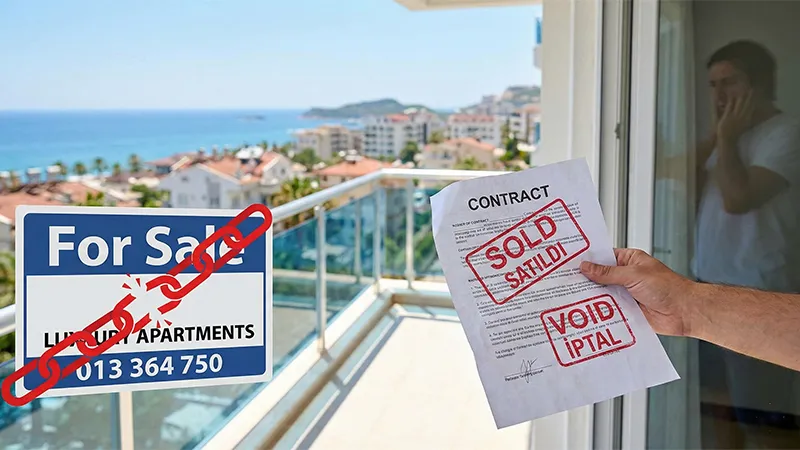
The process of foreign investment in the Turkish real estate market has undergone fundamental transformations over the past decade. While the country, as a bridge between East and West, has provided unique opportunities for acquiring immovable assets and obtaining citizenship, it has simultaneously become a platform for the emergence of complex fraud networks targeting various layers of investors' financial security. Analysis of registration data and judicial cases shows that fraud in this field is no longer limited to traditional methods; rather, it is carried out through manipulation of valuation systems, forgery of digital documents, and bypassing bank monitoring mechanisms. This report provides a detailed examination of legal structures, modern deception methods, and preventive measures, focusing on the period from 2024 to 2026.
New Laws and Legal Entities for Property Title Registration in Turkey (TAPU)
The foundation of security in Turkish real estate transactions rests upon the "General Directorate of Land Registry and Cadastre" (Tapu ve Kadastro Genel Müdürlüğü - TKGM). This entity is the only legal authority responsible for issuing, registering, and transferring title deeds (TAPU). Unlike many countries where notarized contracts may hold high legal weight in proving ownership, in Turkish law, definitive ownership is achieved only when the transaction is registered in the official offices of this directorate and a physical or digital deed is issued.
In recent years, the Turkish government has launched systems such as "Your Key Türkiye" to increase transparency for international buyers. This portal, available in six languages including English and Arabic, acts as an official guide for foreign nationals to become aware of legal processes with a "government guarantee." However, fraudsters often exploit buyers' lack of familiarity with these systems to steer them toward sham contracts or illegal pre-purchases.
Understanding Types of TAPU Deeds and the Vital Role of the Occupancy Permit (Iskan)
One of the most common platforms for fraud is the lack of transparency regarding the building's completion status or "Iskan." Non-expert buyers often do not understand the differences between various deeds, which can lead to purchasing properties that are legally uninhabitable or face heavy municipal fines.
| Deed Type (TAPU) | Legal Status Description | Risk Level for Buyer |
|---|---|---|
| Floor Ownership (Kat Mülkiyeti) | Final building approval; has occupancy permit (Iskan) and aligns with municipal plans. | Very Low (Safest state) |
| Floor Easement (Kat İrtifakı) | Indicates ownership of a unit under construction; Iskan not yet issued but plans are approved. | Medium (Requires municipal inquiry) |
| Lacking Iskan (Iskansız) | A physically built property that failed to obtain Iskan due to construction violations. | Very High (High probability of no final deed transfer) |
Analysis shows that properties lacking Iskan are often advertised at very tempting prices on online platforms. Fraudsters claim that "Iskan is being processed" to persuade the buyer to pay the full transaction price, while many of these projects will never obtain legal permits due to tax debts or failure to meet safety standards (especially following the 2023 earthquakes).
Latest Fraud Methods in Obtaining Turkish Citizenship via Property Purchase (2026)
The Turkish citizenship-by-investment program through property purchase entered a new phase of oversight in 2022 when the investment threshold was increased to $400,000. This program, under the direct supervision of the Ministry of Environment, Urbanization, and Climate Change, faced major security challenges in 2024 and 2025, leading to the revocation of hundreds of citizenships.
Exposure of Operation "Babatak"; A Massive Corruption Case in Turkish Property Valuation
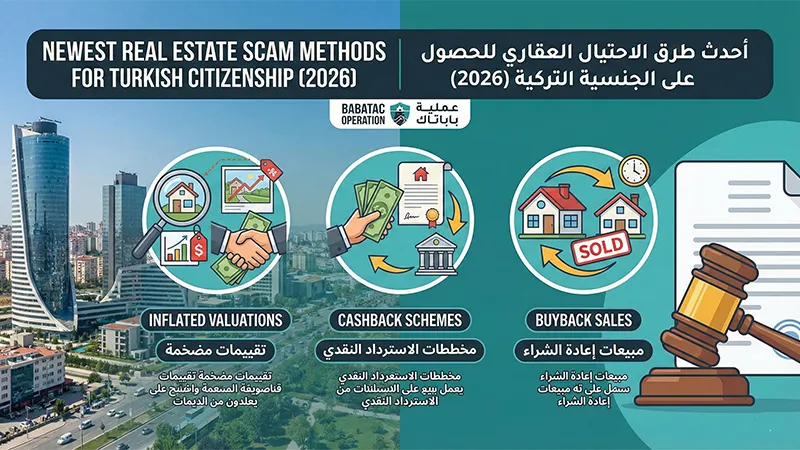
In late 2025, the Turkish Ministry of Interior uncovered an organized fraud network operating under the code name "Babatak." This network aimed to bypass the $400,000 minimum investment requirement by creating sham and manipulated transactions. The mechanism of this fraud relied on three main pillars:
-
Inflated Appraisals: Fraudsters, in collaboration with some corrupt appraisal companies, would record a property worth $200,000 in reality as $400,000 in official reports so the buyer could apply for citizenship.
-
Cash-back Schemes: The buyer would deposit $400,000 through bank channels, but immediately after receiving approval, a portion of this money would be returned to the buyer by the seller under various guises. This act legally constitutes a failure to meet the investment floor and leads to the revocation of citizenship rights.
-
Buy-back Sales: According to these illegal agreements, the property would be sold back to the developer at a much lower price after receiving the passport and the expiration of the 3-year period, indicating the sham nature of the original investment.
The consequence of this case in 2025 was the initiation of citizenship revocation for 451 foreign investors whose assets, including 1,240 apartments and 65 plots of land, were seized by the government. This event is a serious warning for investors seeking "shortcuts" to obtain a passport, as the Turkish government's new monitoring systems use AI and bank data matching to track any discrepancy between market value and transaction price.
| Vital Sections of the Appraisal Report (2025) | Importance for Fraud Prevention |
|---|---|
| Registration Record Review | Ensuring the property is not under judicial seizure or bank mortgage. |
| Area Verification | Fraudsters often sell common areas as the net area of the unit. |
| Usage Confirmation | Preventing the sale of commercial or office units as residential (which causes residency issues). |
| Regional Price Analysis | Comparing the unit price with at least 3 similar cases in the same neighborhood to prevent overpricing. |
Internet Fraud in Turkish Home Buying; Deception on Real Estate Listing Sites
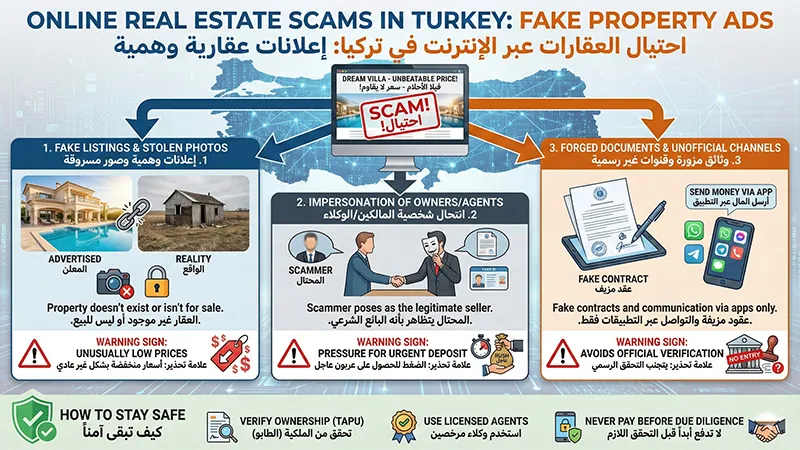
With the widespread use of platforms like Sahibinden, Emlakjet, and social networks, digital real estate fraud in Turkey has increased sharply. Complaints registered on the Şikayetvar platform in 2025 reveal recurring patterns targeting general buyers.
Fake Ad Traps or "Ghost Listings" in Istanbul and Izmir Markets
Fraudsters publish images of ultra-luxury apartments in areas like "Beşiktaş" or "Kadıköy" at unbelievable prices (e.g., 50% below market price). When a customer calls, they claim the property has just been sold or a deposit has been paid, but they have other units in peripheral areas like "Esenyurt" or "Arnavutköy." The goal is to generate leads and then apply psychological pressure to sell inferior units.
Some high-risk areas based on 2025 complaint data include:
-
Istanbul (Esenyurt and Beylikdüzü districts): The highest reports regarding the sale of units without deeds or deeds mortgaged to the bank.
-
Izmir (Buca district): Numerous complaints regarding fake and manipulated listings.
-
Düzce and Ankara: Reports of selling illegal prefabricated houses on agricultural lands.
Risks of Paying a Deposit (Kapura); How to Not Lose Your Advance Payment?
This method, the simplest yet most used type of fraud, involves receiving amounts between $1,000 and $5,000 as a deposit to "reserve" the property. The fraudster, who often isn't even the owner, uses a sense of urgency and claims of other buyers to convince the customer to transfer funds to a personal account and disappears immediately after receiving the money. According to 2026 Turkish regulations, any deposit payment must be documented by a preliminary contract and preferably through banking systems citing the property's registration number.
TapuTakas System; The Safest Method for Property Payment Transfer in Turkey
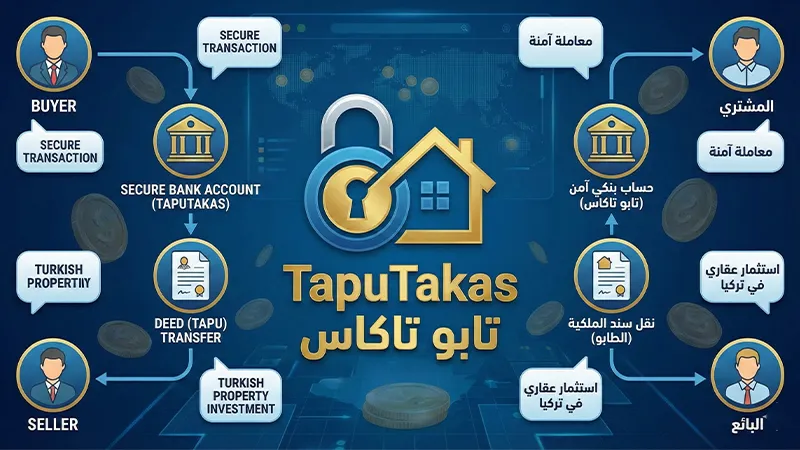
One of the biggest concerns for foreign buyers is the security of fund transfers on the day of title transfer. Fraudsters often exploit the time gap between "paying the money" and "signing the deed." To solve this, "Takasbank" (Turkey's Settlement and Custody Bank) launched the TapuTakas system, recognized in 2025 as the safest transaction method.
Step-by-Step Guide to Using the TapuTakas System for Foreign Buyers
This system acts as an "Escrow" account. In this process, the transaction funds are transferred to an account in Takasbank under the supervision of the Land Registry Office instead of being deposited directly into the seller's account. The money remains blocked in this account and is only released to the seller when the electronic system of the Land Registry Office confirms the finalization of the title transfer to the buyer.
| Operational Steps in the TapuTakas System (2026) | Technical Details |
|---|---|
| Registration at the Tapu Office | The seller receives a transaction tracking number (e-payment receipt number). |
| Entering the TapuTakas Portal | Both parties register on the site with identity info and tax numbers. |
| Deposit by Buyer | The exact transaction amount is deposited into the designated Takasbank account and confirmed by the system. |
| Signing the Deed | Parties visit the Tapu office and sign the deed. |
| Automatic Fund Transfer | As soon as the signature is recorded, the bank deposits the money into the seller's account and sends a confirmation SMS to both parties. |
Using this system completely eliminates risks such as carrying cash, forged checks, or the seller fleeing after receiving payment. The fee for this system in 2025 is a negligible amount (about 70 to 100 Lira), which is highly valuable compared to the security provided.
Banking Challenges and OFAC Sanctions for Property Purchase by Iranians in Turkey
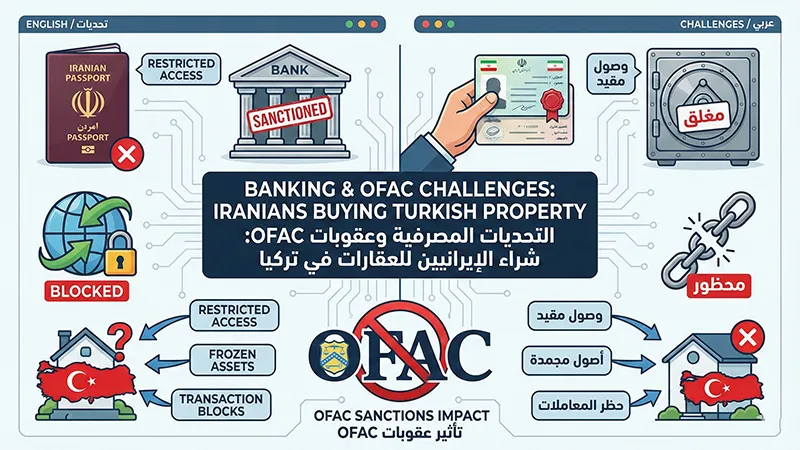
Iranian investors in the Turkish real estate market face an additional layer of risk stemming from international sanctions and banking restrictions. In 2024 and 2025, U.S. Treasury (OFAC) oversight of financial flows entering Turkey has intensified.
Guide to Obtaining a Currency Purchase Certificate (DAB) and Legal Transfer from Iran
According to new Turkish banking laws, foreign nationals are required to provide a "Currency Purchase Certificate" (Döviz Alım Belgesi) for property purchases. This law requires that foreign currency (USD or EUR) first be transferred to a Turkish domestic bank and then sold to the Central Bank of Turkey so that its Lira equivalent can be used for the property purchase. For Iranians, due to the disconnection of the SWIFT system, this process is often done through exchange offices (Sarraafi).
Security Warnings for Iranians:
-
Avoiding Unlicensed Exchange Offices: Using traditional transfer systems lacking official invoices and bank tracking codes can lead to the blocking of the Central Bank account and failure to issue the DAB certificate.
-
Cryptocurrency Risks: In 2025, the Turkish Land Registry Office applies strict monitoring to the origin of funds provided via cryptocurrency. Decentralized exchanges operating with Iranian IPs are blacklisted, and assets related to them may be frozen in Turkish destination banks.
-
The Halkbank Case: The ongoing legal case of Halkbank in the U.S. has led to extreme sensitivity of Turkish state banks (Ziraat and Vakıf) toward large transactions by Iranian nationals. It is recommended that all documents regarding the "Source of Funds," including deeds of property sale or business in Iran, be translated and ready for presentation.
High-Risk Areas and Real Estate Fraud Hubs in Istanbul and Major Cities
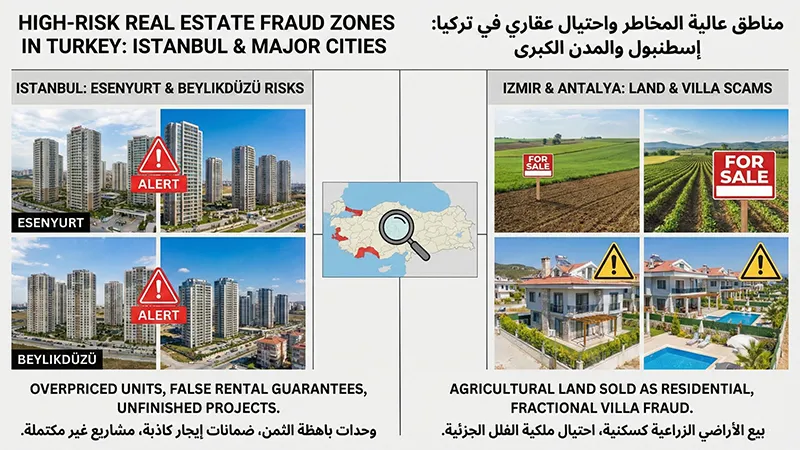
The Turkish real estate market is not uniform, and the security level varies sharply across regions. Analysis of registration data and police reports in 2025 shows that some areas have become hubs for fraudster activity due to high density of construction projects and a large presence of foreign nationals.
Risk Assessment for Buying Property in Esenyurt and Beylikdüzü, Istanbul
Istanbul remains the number one investment destination, but the highest volume of fraud also occurs in this city.
-
Esenyurt District: Due to low prices, this area is the primary hub for frauds related to "multiple sales of a single unit to several people" and unfinished projects that never receive a deed due to the developer's debt to the municipality.
-
Beylikdüzü District: Fraud in this area mostly revolves around "ghost rentals" and the sale of units registered as office space (Home-Office) but sold as residential.
-
Luxury Projects in "Ulus": Even in expensive areas, risks exist. In 2025, a case involving $1 million embezzlement by managers of a luxury complex in Ulus through fake maintenance fees and forged renovation costs made headlines.
Fraud in Agricultural Land Sales and Shared Villas in Izmir and Antalya
In Izmir and Antalya, frauds are more legal in nature:
-
Agricultural Lands (Tarla): Fraudsters sell agricultural lands lacking building permits to foreigners at residential land prices, claiming they will "soon change usage." According to Turkish law, foreign nationals who buy land without a building are obliged to present their construction project to the ministry within 2 years; otherwise, the land is confiscated by the state.
-
Shared Villas: Selling villas that do not have an independent deed and are transferred as "shared" (Hisseli Tapu) is one of the biggest legal challenges in Antalya. In this case, the buyer does not own the entire structure and requires permission from all partners for any changes or future sale.
Final Checklist of Legal Inquiries Before Signing the Property Purchase Contract
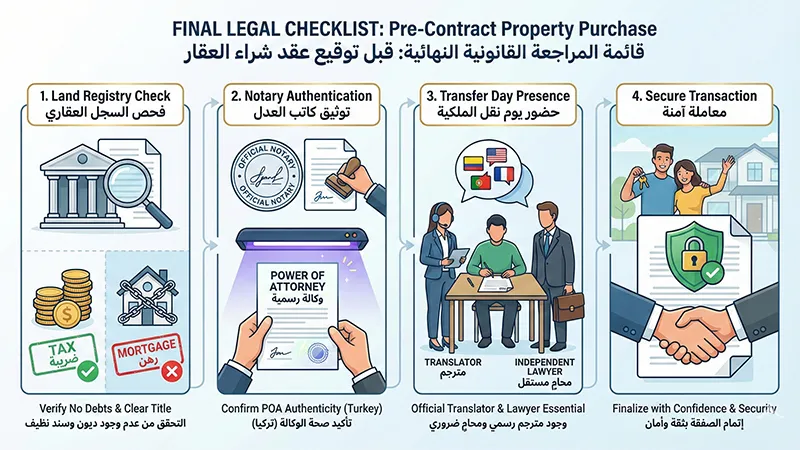
For a non-expert buyer, safe navigation through the Turkish property purchase process requires adherence to strict protocols. Below is the final checklist to ensure transaction security.
Guide to Online Property ID Inquiry in the Parsel Sorgulama System
Before any serious negotiation, the buyer must enter the property coordinates into the parselsorgu.tkgm.gov.tr system. This government system allows you to:
-
Ensure the claimed geographical position matches official maps.
-
Check the type of land use (residential, commercial, or agricultural).
-
View the exact land area and building status.
How to Check Property Tax Debt and Bank Mortgages at the Land Registry Office
Many properties in Turkey are under mortgage (Ipotek) due to bank loans or the seller's tax debts, or have been seized by the court (Haciz).
-
Solution: The buyer or their lawyer must request a "Status Inquiry Sheet" (Tapu Kayıt Örneği) from the Land Registry Office. This document shows all legal restrictions on the property. Never buy a property with a "bank mortgage" unless the mortgage discharge is done simultaneously with the title transfer in the banking system.
Security Tips for Verifying Power of Attorney Authenticity in Turkish Notary Offices
If the seller is not personally present, their Power of Attorney (POA) must be strictly scrutinized. Fraudsters often use voided or forged POAs.
-
Solution: Authenticity of POAs issued within Turkey can be inquired through the e-Government portal (e-Devlet). For POAs issued abroad, the presence of an Apostille stamp and Turkish consulate confirmation is mandatory.
The Necessity of a Sworn Interpreter and Independent Lawyer on Title Transfer Day
According to Turkish law, if one party to the transaction is not fluent in Turkish, the presence of a "Sworn Interpreter" at the Land Registry Office is mandatory.
-
Warning: Never use an interpreter introduced by the real estate agency or the seller. The interpreter is obliged to translate all clauses of the deed and any restrictions listed on the back of the deed for you. Fraudsters often collude with the interpreter to hide mortgages or loans on the property from the buyer.
Essential Actions After Buying Property; Taxes and Maintenance Costs
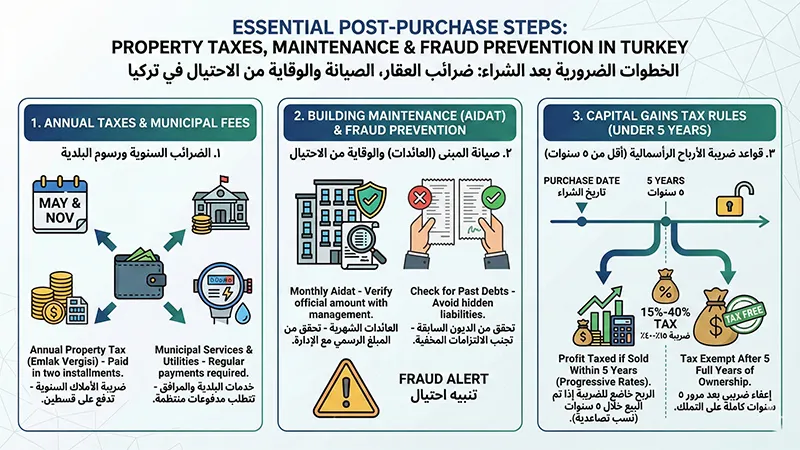
Investment security is not limited only to the moment of purchase. Many frauds occur during ownership or at the time of property sale.
Guide to Paying Property Tax and Annual Municipal Duties in Turkey
Failure to pay annual property duties (Emlak Vergisi) can lead to heavy fines and eventually property seizure by the municipality.
-
Tax Rate: For residential properties in metropolitan cities like Istanbul, the annual tax rate is 0.2% of the property value. Buyers must pay this amount to the local municipality in two installments (May and November) each year.
Preventing Fraud in Building Maintenance Fees (Aidat) and Management Costs
In large residential complexes (Site), management may unrealistically increase maintenance costs (Aidat) or define sham renovation projects.
-
Solution: According to the Turkish Civil Code, all owners have the right to inspect the complex's financial statements. Foreign buyers should participate in General Assembly meetings (Kat Malikleri Kurulu) or send their lawyer to oversee costs.
Property Sale Tax and Capital Gains Laws in Turkey (Under 5 Years)
If you sell a property before 5 years of ownership, you are obliged to pay tax on the profit from the sale. Fraudsters encourage the buyer at the time of purchase to register the property price in the deed at a value lower than actual to pay less "transfer tax." However, this leads to a stark difference between buy and sell prices at the time of resale, exposing the buyer to heavy "capital gains" taxes.
Methods for Identifying and Verifying Legal Real Estate Agencies in Turkey
Working with a reputable real estate agency is the first line of defense against fraud. In 2025, operating an unlicensed agency in Turkey is considered a crime and subject to heavy fines.
How to Validate a Real Estate Agency in Turkey?
-
Check Business Registration Number (Ticaret Sicil): All legal companies must be registered in the official gazette. You can search the company name on the ticaretsicil.gov.tr website.
-
Real Estate Authorization Certificate (Taşınmaz Ticareti Yetki Belgesi): The agency is obliged to display its authorization tracking code received from the Ministry of Commerce in its office or place it on its website.
-
Physical Office: Strictly avoid transacting with intermediaries who only meet via WhatsApp or in cafes. Having a registered physical office with a verified location on Google Maps is a primary criterion for trust.
Final Summary and Secure Property Purchase Strategy in Turkey (2026)
A deep analysis of the Turkish real estate market in the 2024–2026 period shows that alongside price growth opportunities and residency benefits, there are complex layers of organized threats. Modern fraud no longer occurs in dark alleys, but in sleek offices through manipulation of valuation systems and exploitation of banking oversight gaps.
Summary of Strategic Recommendations:
-
Take the $400,000 Rule Seriously: Any offer to bypass this amount through cash-backs or inflated appraisals carries a definite risk of citizenship revocation and asset seizure.
-
Transact Digitally: Use the TapuTakas system for payment and WebTapu for inquiries. These systems are designed to eliminate human error and fraud.
-
The Appraisal Report is Your Bible: Carefully read the content of the SPK expert report. If the area or price in the report differs from what the seller says, stop the transaction immediately.
-
Independent Lawyer, Not Developer's Lawyer: Never use a lawyer introduced by the real estate agency or the developer. Conflict of interest in these cases is the biggest cause of failed investments.
Investing in property, especially in a foreign country, is not just a business transaction, but a complex legal process. Awareness of laws, using government monitoring tools, and maintaining financial transparency are the only ways to turn this investment into a secure and profitable asset in the 2026 horizon.